The National Eligibility cum Entrance Test (NEET) is conducted by the National Testing Agency (NTA) for admission to MBBS, BDS, AYUSH, BSc Nursing, and other undergraduate medical and allied health programs at government and private colleges across India.
A Quick Note on NEET 2026
If you’re researching NEET for the first time, it’s worth knowing what happened last year. The NEET UG 2026 exam was originally held on 3 May 2026, but was cancelled after paper-leak allegations and reports of irregularities from several states. NTA rescheduled the exam as a re-examination on 21 June 2026. It’s a reminder that even a well-established exam calendar can shift — so build some flexibility into your own preparation timeline rather than counting down to a single fixed date.
NEET 2027 Exam Date
NTA has not yet released an official notification for NEET 2027. Based on the agency’s pattern over the last several years — NEET has consistently landed on the first Sunday of May — the exam is widely expected around 2 May 2027. Treat this as a working estimate, not a confirmed date.
Expected timeline:
| Event | Expected Window |
|---|---|
| Notification & registration opens | February 2027 |
| Last date to apply | March 2027 |
| Admit card release | Late April 2027 |
| Exam date | 2 May 2027 (tentative) |
| Result declaration | June 2027 (tentative) |
Keep checking the official NTA site (neet.nta.nic.in) directly rather than relying on secondary sources for the confirmed date once it’s announced.
NEET 2027 Eligibility Criteria
Academic qualification: You must have passed (or be appearing for) 10+2 with Physics, Chemistry, Biology/Biotechnology, and English as core subjects, from a recognized board.
Minimum marks required in Class 12:
- General category: 50%
- General-PwD (physically handicapped) category: 45%
- SC/ST/OBC category: 40%
Age criteria: You must be at least 17 years old by 31 December of the exam year. There is currently no upper age limit — this was relaxed in recent years following a court ruling, though policy could still change with future NTA/NMC notifications.
Nationality: Indian nationals, NRIs, OCIs, PIOs, and foreign nationals are all eligible to apply.
NEET 2027 Exam Pattern
A few things about the pattern have changed since the older (pre-2021) format, so don’t rely on outdated descriptions floating around online.
- Mode: NEET has historically been an offline, pen-and-paper (OMR-based) exam. Some recent reports suggest a possible shift to computer-based testing (CBT) starting in 2027, but this has not been officially confirmed by NTA as of this writing — treat it as unverified until the official notification arrives.
- Duration: 3 hours 20 minutes
- Total questions offered: 200 (across all sections)
- Questions you must attempt: 180
- Marking scheme: +4 for each correct answer, −1 for each incorrect answer, 0 for unattempted questions
- Maximum marks: 720
Each subject is split into two sections — Section A (compulsory) and Section B (choice-based, offering a few extra questions so you can skip ones that don’t look familiar):
| Subject | Questions Offered | Questions to Attempt | Marks |
|---|---|---|---|
| Physics | 50 (35 + 15) | 45 | 180 |
| Chemistry | 50 (35 + 15) | 45 | 180 |
| Biology (Botany + Zoology) | 100 (50 + 50) | 90 | 360 |
| Total | 200 | 180 | 720 |
Since the notified official syllabus and pattern can still shift year to year, always cross-check against NTA’s latest information bulletin once it’s released — don’t rely solely on last year’s structure.
A note on conflicting reports: Most sources describe the choice-based structure above (200 questions offered, 180 to attempt). However, a few recent reports claim NTA removed Section B for the 2026 cycle and made all 180 questions compulsory, with no extra questions offered. This isn’t consistently confirmed across sources, so treat it as unsettled until NTA’s official 2027 information bulletin clarifies it.
Practice Online:
- NEET Biology Previous Year Questions (2024–2025)
- NEET Chemistry Previous Year Questions (2024–2025)
- NEET Physics Previous Year Questions (2024–2025)
NEET Chapter-Wise Weightage: Where to Focus First
The full syllabus matters, but not every chapter contributes equally to your score. Based on an analysis of the last several years of NEET papers (these are trend-based estimates, not official NTA figures — actual distribution can shift year to year):
High-weightage Physics chapters:
- Current Electricity
- Motion of System of Particles and Rigid Body
- Electronic Devices (Semiconductors)
- Thermodynamics
- Optics (Ray and Wave)
- Electrostatics
- Magnetic Effects of Current and Magnetism
High-weightage Chemistry chapters:
- Chemical Bonding and Molecular Structure
- Aldehydes, Ketones and Carboxylic Acids
- Coordination Compounds
- Equilibrium
- Chemical Kinetics
- Basic Principles of Organic Chemistry
High-weightage Biology chapters:
- Human Physiology (the single highest-yield chapter in the entire syllabus)
- Genetics and Evolution
- Plant Physiology
- Ecology and Environment
- Biotechnology and Its Applications
A rough rule of thumb that shows up across multiple years of analysis: roughly 70-80% of Biology questions come from the Class 12 portion of the syllabus, with the rest from Class 11 — so if you’re short on revision time, weight your Biology review toward Class 12 topics first.
Treat this list as a way to sequence your revision, not as permission to skip chapters entirely — NEET has occasionally surprised aspirants by pulling several questions from a chapter that’s usually low-yield.
NEET 2027 Syllabus
The syllabus is based on the NCERT curriculum for Classes 11 and 12, rationalized and finalized by the National Medical Commission (NMC) and published by NTA — most recently updated in December 2025 for the 2026 cycle, with no further changes announced for 2027 as of this writing. Unlike 2021, when COVID-related disruptions led several boards to temporarily cut down their syllabi, the current syllabus carries no such reduction.
The official syllabus is organized into numbered units across all three subjects (not loose chapter lists) — Biology has 10 units, while Physics and Chemistry each have 20. Two units were added to the syllabus in recent years that didn’t exist in the older NCERT-only structure: a dedicated Experimental Skills unit in Physics, and a Principles Related to Practical Chemistry unit.
Biology Syllabus (10 Units)
- Diversity in Living World
- Structural Organisation in Animals and Plants
- Cell Structure and Function
- Plant Physiology
- Human Physiology
- Reproduction
- Genetics and Evolution
- Biology and Human Welfare
- Biotechnology and Its Applications
- Ecology and Environment
Physics Syllabus (20 Units)
- Physical World and Measurement
- Kinematics
- Laws of Motion
- Work, Energy and Power
- Motion of System of Particles and Rigid Body
- Gravitation
- Mechanical Properties of Solids and Fluids
- Thermodynamics
- Kinetic Theory
- Oscillations and Waves
- Electrostatics
- Current Electricity
- Magnetic Effects of Current and Magnetism
- Electromagnetic Induction and Alternating Currents
- Electromagnetic Waves
- Optics
- Dual Nature of Matter and Radiation
- Atoms and Nuclei
- Electronic Devices
- Experimental Skills (Class 11 & 12)
Chemistry Syllabus (20 Units)
Physical Chemistry:
- Some Basic Concepts in Chemistry
- Atomic Structure
- Chemical Bonding and Molecular Structure
- Chemical Thermodynamics
- Solutions
- Equilibrium
- Redox Reactions and Electrochemistry
- Chemical Kinetics
Inorganic Chemistry: 9. Classification of Elements and Periodicity in Properties 10. p-Block Elements 11. d- and f-Block Elements 12. Coordination Compounds
Organic Chemistry: 13. Purification and Characterisation of Organic Compounds 14. Some Basic Principles of Organic Chemistry 15. Hydrocarbons 16. Organic Compounds Containing Halogens 17. Organic Compounds Containing Oxygen 18. Organic Compounds Containing Nitrogen 19. Biomolecules 20. Principles Related to Practical Chemistry
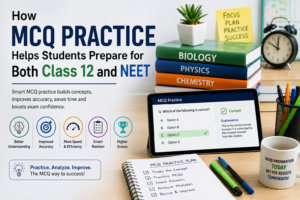
Once you’ve got the syllabus and weightage mapped out, the next step is practice — see how regular MCQ practice sharpens your Class 12 and NEET preparation.
How to Prepare: Subject-Wise Tips
Physics
- Get comfortable with the formula sheet before you go deep into problem-solving — Physics rewards recognition speed under exam pressure.
- Numerical accuracy matters more than volume. Solving 20 problems carefully beats rushing through 50.
- Revisit NCERT diagrams for topics like optics and electromagnetism — NEET occasionally draws questions straight from figure labels.
Chemistry
- Split your time by branch: Physical Chemistry rewards formula practice, Inorganic rewards memorization (flashcards work well), and Organic rewards understanding reaction mechanisms rather than memorizing outcomes.
- Don’t skip “Principles Related to Practical Chemistry” — it’s a newer addition to the syllabus and often under-prepared for exactly that reason.
Biology
- NCERT is non-negotiable here. A large share of Biology questions are drawn directly from NCERT lines and diagrams, not just concepts.
- Redraw diagrams from memory regularly (the human digestive system, plant reproductive structures, the nephron) — recall through drawing sticks better than passive reading.
- Keep a running list of easily confused terms (e.g., similar-sounding hormones or enzymes) and review it weekly.
👉 Boost Your NEET Score with Chapter-Wise MCQ Practice on MCQAdda.in
Common Preparation Mistakes to Avoid
- Ignoring NCERT in favor of reference books too early. Reference books are for depth after NCERT, not a replacement for it.
- Studying Physics and Chemistry with a Biology-style memorization approach. Both require regular numerical and mechanism practice, not just reading.
- Skipping revision of “easy” chapters. Chapters considered low-difficulty are exactly where careless mistakes cost the most marks, since everyone else gets them right.
- Not practicing with negative marking in mind. Guessing randomly on a 4-mark question with a 1-mark penalty is a losing bet unless you can eliminate at least two options.
- Leave mock tests for the final month. Full-length, timed practice needs to start early enough that you can actually act on what it reveals.
Recommended Books (Beyond NCERT)
| Subject | Book | Best For |
|---|---|---|
| Physics | Concepts of Physics (H.C. Verma) | Conceptual clarity and problem-solving |
| Physics | Objective Physics (D.C. Pandey) | NEET-style MCQ practice |
| Chemistry | Physical Chemistry (O.P. Tandon) | Numericals and physical chemistry concepts |
| Chemistry | Organic Chemistry (Himanshu Pandey / GRB) | Reaction mechanisms |
| Chemistry | Objective NCERT at Your Fingertips (MTG) | Quick NCERT-based revision |
| Biology | Objective NCERT at Your Fingertips (MTG) | Line-by-line NCERT-based MCQs |
| Biology | Trueman’s Objective Biology (Vol 1 & 2) | Extended practice beyond NCERT |
NCERT textbooks remain the base for all three subjects — treat the above as supplementary, not a replacement.
Frequently Asked Questions
Is the NEET 2027 syllabus different from 2026? As of this writing, no changes have been announced. NMC typically finalizes and publishes any syllabus updates a few months before the exam, so it’s worth checking back closer to the February 2027 notification.
How many attempts are allowed for NEET? There’s currently no cap on the number of attempts, and no upper age limit — you can appear as many times as you meet the eligibility criteria each year.
Is NEET going to switch to computer-based testing (CBT) in 2027? This is reported by some sources but not officially confirmed by NTA as of now. Continue preparing under the assumption of an offline exam until the official notification says otherwise.
How much of NEET Biology comes from NCERT directly? A large majority of Biology questions are based directly on NCERT text, examples, and diagrams — more so than Physics or Chemistry, which lean more on numerical and mechanism-based application.
What’s a good NEET score to aim for a government medical college? This varies significantly by year, category, and state quota versus All India Quota, so there’s no single safe number — but aspirants targeting top government colleges generally aim well above 650 out of 720. Check the previous year’s official cutoffs on the NTA/MCC site for a category-specific benchmark.
Preparing With Previous Year Questions
Knowing the syllabus is only half the job — the other half is knowing how it actually gets tested. Practicing previous year questions (PYQs) shows you the real difficulty level, recurring chapter weightage, and question patterns behind the syllabus list above.
Practice NEET MCQs and PYQs on MCQADD.in
This article will be updated once NTA releases the official NEET 2027 notification.