If you are a mechanical engineer working or planning to work in Dubai’s construction industry, passing the Dubai Municipality (DM) exam is not optional — it is a legal requirement. Without it, you cannot sign off on mechanical drawings, supervise MEP systems, or be listed as an approved engineer on any Dubai Municipality project.
This guide covers everything you need to know: what the exam is, which categories exist, who is eligible, how to register through the DEQ system, and what to study to pass.
What Is the Dubai Municipality Exam for Mechanical Engineers?
The Dubai Municipality exam is a professional competency assessment conducted through the Dubai Engineering Qualification (DEQ) system. It is designed to assess whether engineers have the technical knowledge and professional competency required to work within their approved engineering specialization and comply with applicable Dubai regulations and requirements.
The process generally starts with document submission through the DEQ portal. Candidates need to upload the required educational, professional, and supporting documents. After the documents are reviewed, the portal shows the engineering examination categories for which the candidate is eligible based on their qualifications and professional profile.
Therefore, you should not assume that you can simply select any mechanical engineering category you want. First, complete the required document submission and check the DEQ portal to see which examination categories are available to you.
Once you know your eligible category, you can prepare specifically for that examination.
Exam Categories for Mechanical Engineers
Dubai Municipality does not have a single mechanical engineering exam. Instead, the exam is divided into categories based on your specialization and the type of company you work for — either a consultancy or a contracting firm.
Under mechanical engineering, there are several recognized specialties. However, the two most in-demand categories in Dubai’s construction market are:
1. Building Mechanical Engineering Services (HVAC)
This is the most common category for mechanical engineers in Dubai. It covers the design, installation, and supervision of:
- HVAC systems (heating, ventilation, and air conditioning)
- Ductwork layouts and air distribution systems
- Chilled water systems and air handling units
- Mechanical ventilation and smoke control systems
- Plumbing and drainage systems within buildings
- Energy efficiency compliance (Al Sa’fat green building standards)
Building Mechanical and HVAC MCQ Set — [Download Now]
🎯 Unlock Free Mock Test
Enter your email and select your exam category.
If you work in a consultancy or contracting company that handles MEP systems for residential towers, commercial buildings, villas, or mixed-use developments, this category is for you.
2. Fire Safety and Protection Engineering Services
This category is for engineers specializing in fire protection systems within buildings. It covers:
- Automatic sprinkler system design and supervision
- Fire hose reels and water storage tank sizing
- Gas-based suppression systems (FM200, CO2, etc.)
- Smoke extraction and pressurization systems
- Fire pump rooms and hydraulic calculations
- Coordination with Dubai Civil Defense (DCD) requirements
Fire Safety and Protection MCQ Set — [Download Now]
Engineers in this category work closely with both Dubai Municipality and Dubai Civil Defense for drawing approvals. Demand for this specialization has grown significantly with the expansion of high-rise and mixed-use developments across Dubai.
Other mechanical engineering categories also exist under the DEQ system — including District Cooling, Industrial, Hydraulic, and Heavy Machinery engineering. We will be releasing dedicated courses for those categories separately.
Eligibility Requirements
Before you can apply for the DM exam, you must meet the following requirements. These apply to both the HVAC and Fire Safety categories.
Academic Qualification A Bachelor’s degree in Mechanical Engineering (or equivalent) from a recognized university. If your degree is from outside the UAE, it must be equalized and attested by the UAE Ministry of Education before you can register.
Work Experience
- Minimum 3 years of relevant post-graduation experience if you hold a Bachelor’s degree
- Minimum 5 years of relevant experience if you hold a diploma
Your experience can be from any country — it does not have to be UAE-based. However, if your experience is from outside the UAE, the experience certificates must be attested by the relevant embassy or official authority in that country.
Society of Engineers Membership: You must be a registered member of the UAE Society of Engineers (SOE). If you graduated outside the UAE, you must also be registered with the engineering syndicate or professional body in your country of graduation.
Sponsoring Company: Your DEQ profile must be linked to a licensed engineering consultancy or contracting company in Dubai that is registered with Dubai Municipality.
How to Apply — DEQ System Step by Step
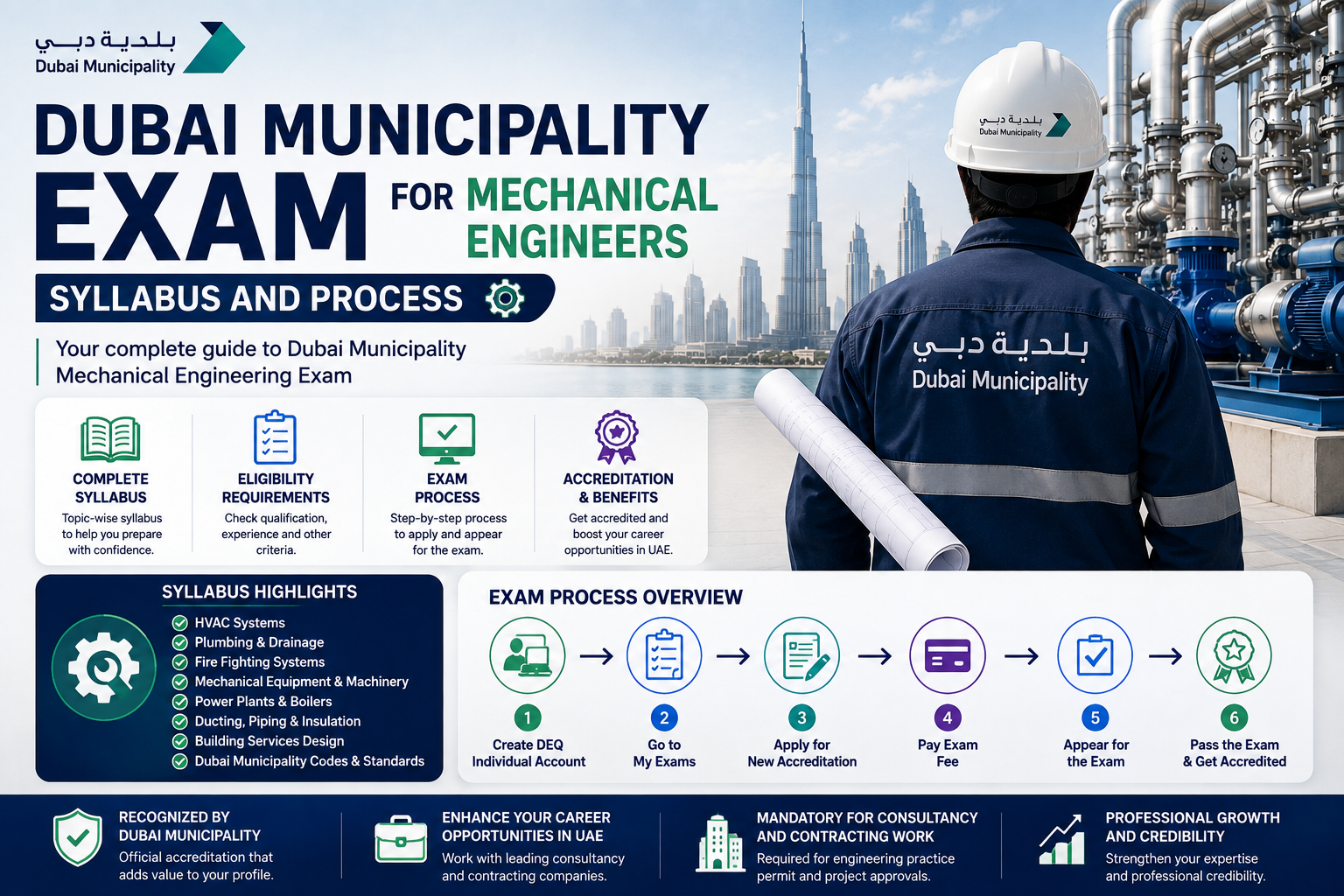
All DM exam applications are handled through the Dubai Engineering Qualification (DEQ) system, which is Dubai Municipality’s online portal for engineer registration and exam booking. Here is the process from start to finish:
Step 1 — Get Your UAE Society of Engineers (SOE) Membership
This is the first step and a mandatory prerequisite. You cannot proceed with the DEQ registration without an active SOE membership. Apply through the SOE website and ensure your engineering specialization is correctly registered (e.g., Building Mechanical Engineering Services).
Step 2 — Create Your DEQ Account
Go to the DEQ portal and create your account. If you already have a UAE Pass, you can use it to log in directly — this speeds up the process and links your profile to official UAE digital ID records.
Step 3 — Upload Your Documents
Once your account is created, upload the following documents:
- Bachelor’s degree certificate (attested and equalized if from outside UAE)
- Experience certificates (attested if from outside UAE)
- Passport copy
- UAE residence visa copy
- Emirates ID copy
- SOE membership certificate
Make sure all documents are in high-quality PDF format. Blurry scans or incomplete certificates are a common reason for application delays.
Step 4 — Select Your Exam Category
After your documents are reviewed and approved by the system, the DEQ portal will automatically show you the exam categories you are eligible for based on your qualifications and experience. Select your relevant category — either Building Mechanical (HVAC) or Fire Safety and Protection.
Step 5 — Pay the Exam Fee
Pay the applicable fee through the portal. Fees typically range between AED 410 and AED 510 depending on the category. Payment can be made online via card or through other available digital payment options.
Step 6 — Schedule Your Exam Date
After payment, you can select your preferred exam date and time slot from the available options in the DEQ portal. You will receive a confirmation email with the exam details.
Important: Exam fees are non-refundable once payment is confirmed. However, you can reschedule your exam at any time before the scheduled date by logging into the DEQ portal. If you need to cancel, you have up to one year to rebook the same exam.
Step 7 — Attend the Exam
On exam day, bring your Emirates ID or passport for check-in. The exam is fully digital and conducted at a designated DM exam centre.
Exam Format
Before diving into the syllabus, understand what the exam looks like:
| Detail | Information |
|---|---|
| Format | Computer-based, Multiple Choice Questions (MCQ) |
| Number of Questions | 25 questions |
| Time Limit | 60 minutes |
| Negative Marking | None |
| Pass Mark | Minimum 70% (approximately 18 out of 25 correct) |
| Results | Shown instantly on screen after completion |
| Retake Policy | Can reapply after a waiting period (typically 30 days); new fee applies |
Exam Syllabus
Building Mechanical Engineering (HVAC) — Key Topics
The HVAC exam focuses on your ability to apply mechanical engineering principles within the context of UAE regulations and building codes. Key areas include:
Dubai Building Code and Local Regulations
- Dubai Mechanical Services Design Guide
- Al Sa’fat Green Building Rating System (energy efficiency requirements)
- Minimum ventilation and indoor air quality standards as per DM requirements
HVAC System Design
- Cooling load calculations (ASHRAE standards)
- Duct sizing and air distribution design
- Chilled water system design and equipment selection
- Air handling unit (AHU) and fan coil unit (FCU) selection
- Fresh air and exhaust air calculations
Plumbing and Drainage
- Water supply system design (hot and cold)
- Drainage and soil pipe sizing
- Grease trap requirements for commercial kitchens
- Water tank sizing and booster pump systems
Energy and Efficiency
- ASHRAE 90.1 energy efficiency standards
- Insulation requirements for ductwork and pipes
- Variable refrigerant flow (VRF) systems
Mechanical Drawings and Specifications
- Reading and interpreting MEP drawings
- Equipment schedules and technical specifications
- Coordination between HVAC, structural, and architectural drawings
Building Mechanical and HVAC MCQ Set — [Download Now]
Fire Safety and Protection Engineering — Key Topics
The Fire Safety exam is more specialized and requires a strong understanding of both DM and Dubai Civil Defense (DCD) regulations.
UAE Fire and Life Safety Code
- Dubai Civil Defense fire code requirements
- Fire safety requirements within the Dubai Building Code
- Occupancy classifications and fire protection requirements per building type
Fire Suppression Systems
- NFPA 13 — Sprinkler system design principles
- Hydraulic calculations for sprinkler systems
- Water storage tank and fire pump sizing
- Fire hose reel layout and coverage requirements
Gas-Based Suppression Systems
- FM200, CO2, and clean agent system design
- Protected enclosure requirements and agent quantity calculations
Smoke Control and Evacuation
- Smoke extraction system design
- Stairwell and lobby pressurization
- Car park ventilation and smoke management
Fire Alarm Integration
- Relationship between fire protection and fire alarm systems
- Zoning requirements and detection layouts (general awareness)
Drawings and Approvals
- DM drawing submission requirements for fire protection
- DCD coordination and approval process
- As-built drawing requirements
Fire Safety and Protection MCQ Set — [Download Now]
Exam Preparation Tips
Focus on local codes first. The DM exam tests your knowledge of UAE and Dubai-specific regulations, not just general engineering theory. Make the Dubai Building Code and the Dubai Mechanical Services Design Guide your primary study materials.
Study ASHRAE and NFPA standards. For HVAC candidates, ASHRAE 62.1 (ventilation) and ASHRAE 90.1 (energy efficiency) are frequently tested. For Fire Safety candidates, NFPA 13 (sprinklers) is essential.
Practice with MCQ-style questions. The exam is 25 MCQs in 60 minutes — that is less than 2.5 minutes per question. Practising with timed mock questions builds speed and confidence.
Understand calculations, not just concepts. The exam includes practical calculation-based questions — cooling load, duct sizing, pipe sizing, hydraulic calculations. Do not rely on theory alone.
Review your day-to-day project experience. Many questions are based on real-world scenarios that a practicing mechanical engineer would encounter. Your site and design experience is valuable preparation.
Prepare with DM Code–Focused MCQ Sets
Strengthen your preparation with MCQ practice sets covering important Dubai Municipality (DM) codes and UAE requirements for mechanical engineering professionals.
Each set focuses on important DM codes, UAE regulations, and exam-relevant concepts. These are targeted MCQ practice materials,
Final Summary
| Building Mechanical (HVAC) | Fire Safety & Protection | |
|---|---|---|
| Who It’s For | MEP/HVAC engineers in consultancy or contracting | Fire protection engineers |
| Experience Required | 3 years (degree) / 5 years (diploma) | 3 years (degree) / 5 years (diploma) |
| Key Codes | Dubai Building Code, ASHRAE, Al Sa’fat | UAE Fire Code, DCD, NFPA 13 |
| Exam Format | 25 MCQ, 60 mins, 70% pass | 25 MCQ, 60 mins, 70% pass |
| Portal | DEQ System (Dubai Municipality) | DEQ System (Dubai Municipality) |
Passing the Dubai Municipality exam as a mechanical engineer is a significant milestone — it is what separates a licensed, recognized professional from an uncertified one in Dubai’s regulated construction market. Follow the steps above, prepare with the right material, and you will be well on your way to becoming a DM-approved mechanical engineer.