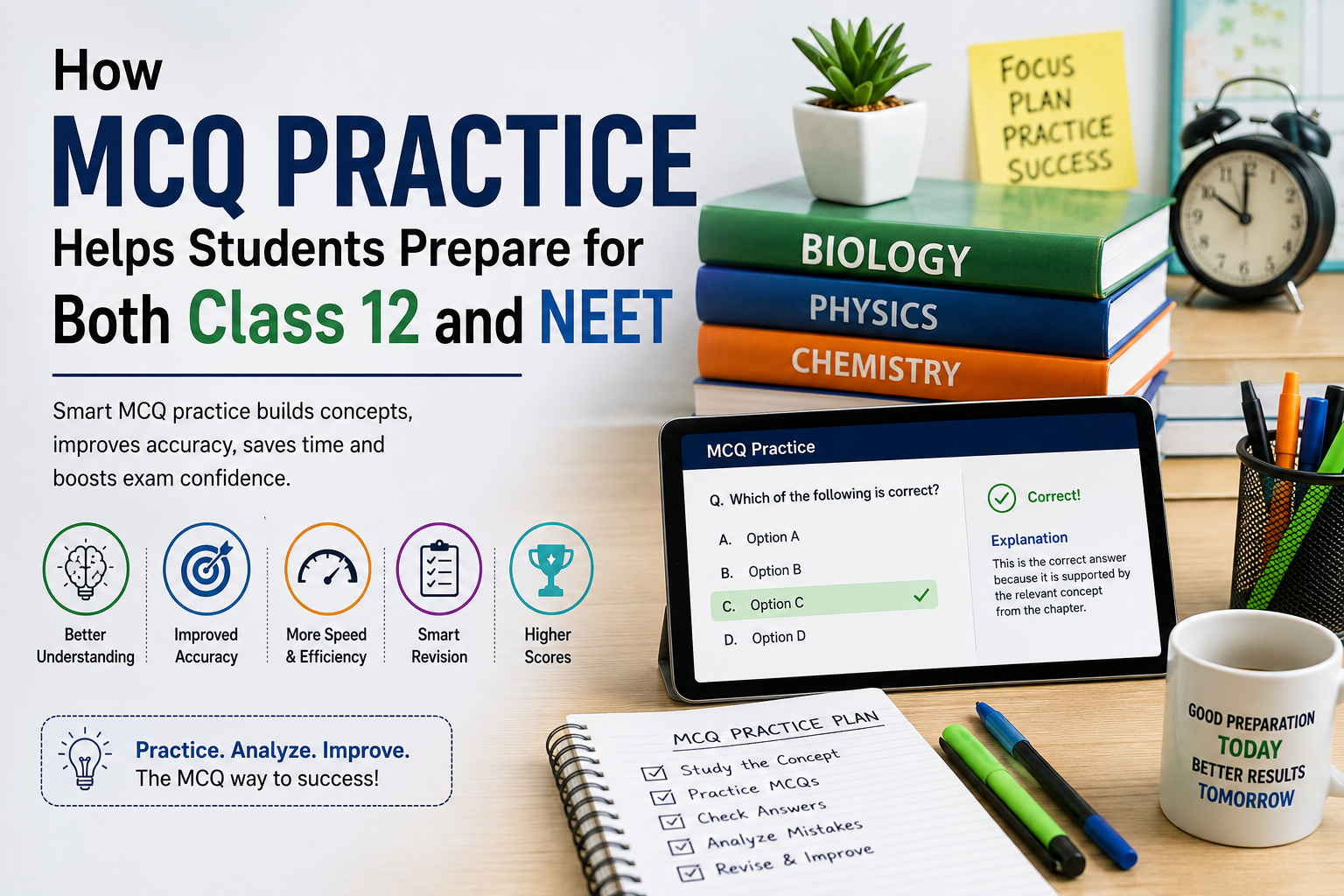
Most students don’t fail because they didn’t study. They fail because they never tested whether the studying actually worked.
You can read an NCERT chapter three times and still blank out on a question that uses the same concept in a slightly different way. It happens to almost everyone preparing for Class 12 boards or NEET — and it’s usually not a memory problem. It’s a practice problem.
That’s the gap MCQs are supposed to close — and it’s why regular MCQ practice ends up doing more for your Class 12 and NEET preparation than another round of rereading ever will.
1. MCQs Force Your Brain to Actually Retrieve Information
Reading is passive. Your eyes move across the page, the information registers, and you move on.
Answering a question is different. Your brain has to go find the answer on its own, without the text sitting right in front of you.
Try this after your next Biology chapter: close the book and answer ten questions from memory. If you get most of them right, good — you know the material. If you don’t, you’ve just found out what needs another look before the exam tells you the hard way.
A rough cycle that works for most students:
Learn → close the book → answer questions → check → go back and fix the gaps
It’s not glamorous, but it beats rereading the same paragraph for the fourth time.
2. MCQs Show You the Difference Between Reading and Understanding
Here’s a situation almost every student has been in: you’ve read the chapter, maybe twice, and you still freeze on a question that should be easy.
That’s because recognizing information in a textbook and using it somewhere new are two different skills. A question might take a concept you know well and drop it into a scenario you haven’t seen before — combine it with another idea, twist the wording, whatever.
If you can’t answer it, that’s not always a sign you didn’t study. Sometimes it means you understood the words but not the idea.
Which is really the question worth asking: can you use what you studied, not just whether you read it. For NEET especially, that distinction decides a lot of scores.
3. Previous Year Questions Tell You What the Exam Actually Wants
You can find practice questions from a hundred different sources, but Previous Year Questions carry a weight the others don’t — they came from a real exam.
Go through enough PYQs, and you start noticing patterns: which topics keep coming back, how a familiar concept gets rephrased, what the difficulty level actually looks like versus what you imagined it would be.
Don’t rely only on random question banks. Once you’ve finished a chapter, pull the PYQs connected to it. That’s usually where the gap between “I studied this” and “I can answer this” shows up.
Where to Practice Class 12 and NEET PYQs Online
If you’re looking for a place to do this, MCQADD.in has PYQ practice for Class 12 and NEET, with instant answer checks and explanations.
For Class 12, the platform covers previous-year Biology MCQs going back five years — useful if you’re revising for boards and want exam-pattern questions instead of generic ones.
Practice Class 12 MCQs and Previous Year Questions on MCQADD.in
NEET aspirants can work through Physics, Chemistry, Botany, and Zoology questions, including PYQs.
Practice NEET MCQs and PYQs on MCQADD.in
4. Practice Teaches You to Spot a Question in Disguise
Exams rarely ask a concept the exact way your textbook does.
The same idea can show up as a plain factual question, a conceptual one, an application-based problem, a statement you have to evaluate, or an assertion-reason pair. Sometimes it’s several concepts stitched into one question.
The more MCQs you work through, the faster you get at recognizing what’s actually being tested underneath the phrasing — instead of panicking because the question “looks” unfamiliar when the concept behind it isn’t.
5. Practice Builds Faster Decisions Under Pressure
During an actual exam, there’s no time to sit and deliberate over every question the way you might while studying at home.
You’re constantly making small calls — do I know this, can I eliminate an option, should I skip this and come back, am I confident enough to lock this in, is this taking too long.
That kind of judgment doesn’t come naturally. It comes from doing it enough times that it becomes automatic. Which matters a lot more in something like NEET, where the clock is unforgiving.
6. MCQs Can Tie Class 12 and NEET Prep Together
Studying the same subject for two different exams can feel like double the work. It doesn’t have to be.
A rough flow that works for a lot of students:
Study the Class 12 chapter → go over the NCERT section again → practice Class 12-level questions → move to NEET-level questions on the same topic → review whatever you got wrong.
The base knowledge doesn’t change — only how deep you push it. Board students can stay focused on their syllabus, while NEET aspirants layer on tougher, competitive-level questions and PYQs on top of the same foundation.
Also Read: NEET 2027 syllabus, eligibility criteria, exam pattern, and prep tips
7. The Explanation Matters More Than the Answer
Getting a question wrong isn’t really the bad part. Not reviewing why you got it wrong — that’s the part that costs you marks later.
Say you picked B and the answer was C. Seeing “incorrect” in red doesn’t teach you anything by itself.
A decent explanation should tell you why C is right, why B seemed right but wasn’t, what concept the question was actually testing, and what to watch for next time you see something similar.
Treat MCQs as a scoring exercise and you’ll plateau. Treat every wrong answer as a lesson and you’ll actually improve.
8. Add a Timer Once You’ve Got the Concepts Down
Don’t chase speed early on. Get the understanding right first.
A reasonable progression looks like this: solve without a clock, then start timing yourself just to see where you stand, then set an actual limit, then mix in questions from different chapters under exam-like conditions.
Rush this, and you end up guessing fast instead of solving fast — which isn’t the same thing.
9. Watching Your Scores Improve Builds Real Confidence
Confidence isn’t just a feeling that you’ve “studied enough.” It comes from proof — from actually answering things correctly and watching that number go up.
A student might start at 60% on a topic, get to 72% after a round of revision, then 82% after more practice. That climb tells you something no amount of rereading notes ever will.
And when a practice session goes badly — which it will, sometimes — that’s not a reason to panic. It’s information. Better to find the weak spot now than in the exam hall.
10. Let MCQs Decide What You Revise Next
Closer to the exam, the question every student asks is: what do I even revise first?
Instead of giving every chapter equal time, look at your MCQ results. If one topic keeps tripping you up while another feels solid, that’s your answer — the weak one gets the extra hours.
Practice, spot the weak points, revise those specifically, then practice again. Repeat as the date gets closer.
11. A Practice Routine That Actually Works
Opening a question bank and grinding through hundreds of MCQs isn’t automatically productive. What tends to work better:
Study the topic using NCERT, your textbook, and class notes — build the base first.
Attempt the question without peeking at the answer. Give yourself a real shot at it.
Flag anything you’re unsure about, even if you land on the right answer by instinct.
Check your answer, then actually read the explanation instead of just noting whether you got it right.
Figure out why you got it wrong — was it a gap in knowledge, a misunderstood concept, a careless read, or a calculation slip? Each of those needs a different fix.
Go back to the concept, not just the question, and revise it properly.
Come back to the same question later and see if it clicks now.
That loop — not the raw number of questions — is what actually moves the needle.
12. Stop Counting Questions and Start Counting Understanding
“I did 300 MCQs today” sounds impressive. It isn’t automatically useful.
Picture two students. One blitzes through 300 questions and barely glances at what they got wrong. The other does 100, but reviews every mistake and goes back to fix the underlying concept.
The second student is almost certainly better prepared, even with a third of the practice volume. Chase accuracy and understanding — the count will take care of itself.
13. Mistakes Worth Avoiding
Peeking at the answer before you’ve really tried. You’re only cheating your own practice.
Memorizing that “C is correct” instead of understanding why. That knowledge won’t transfer to a different question on the same concept.
Skipping past wrong answers without reviewing them. That’s the most useful data you’re generating and most students throw it away.
Only doing easy questions. Fine for a confidence boost, but it won’t prepare you for what the actual exam throws at you.
Never practicing against a clock. Untimed practice teaches concepts. Timed practice teaches the exam.
Grinding more questions instead of fixing the concept behind repeated mistakes. If the same topic keeps beating you, stop solving and start revising.
A Simple Weekly Structure
Monday to Friday: work through questions tied to whatever you’re currently studying.
Saturday: mix in questions from chapters you finished earlier — don’t let old topics go stale.
Sunday: go back over what you got wrong during the week and revise those specific concepts.
Closer to exams, swap some of these sessions for timed PYQs and full mock tests. The exact structure can flex around your own schedule — what matters is doing it consistently, not hitting some arbitrary daily question count.
Where This Leaves You
MCQs don’t replace NCERT, your textbook, or your classroom notes. They work alongside all of it — the part that tells you whether the rest actually stuck.
For Class 12 students, they’re a way to revise the syllabus and get comfortable with how boards phrase questions. For NEET aspirants, they build speed, accuracy, and familiarity with a much more competitive format on top of that same foundation.
Put together, the full loop looks like this: learn the concept, practice MCQs, work through PYQs, review what went wrong, revise the weak spots, practice again, then test yourself under real exam conditions.
Every question you attempt this way isn’t just a mark gained or lost — it’s telling you exactly what you know, what you don’t, and what still needs work before the exam actually happens.