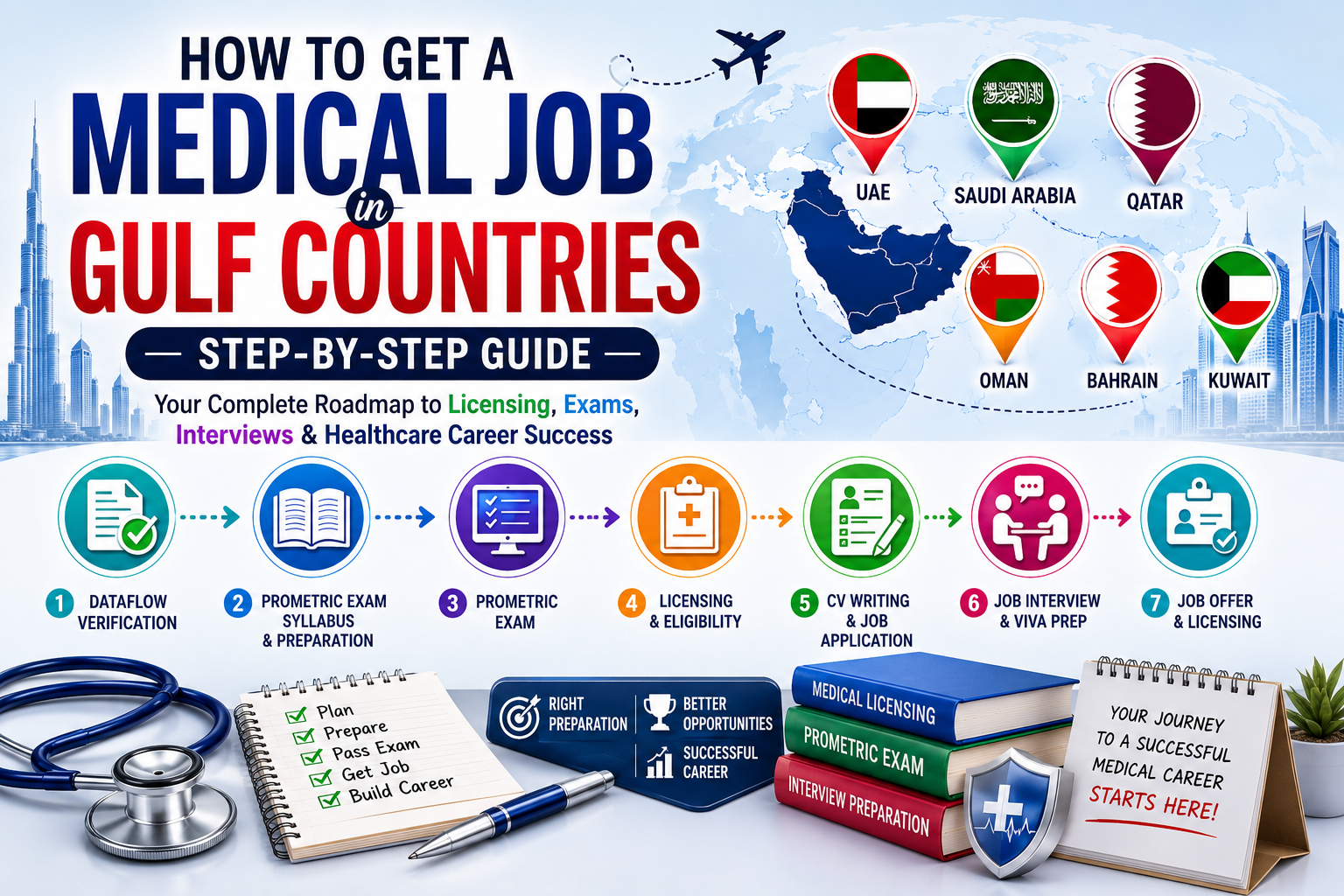
Healthcare opportunities across the Gulf region continue to expand, with hospitals, medical centers, and healthcare organizations actively recruiting qualified professionals from around the world. Success in securing a medical job often depends on more than just academic qualifications.
Candidates who complete their DataFlow verification on time, prepare effectively for the Prometric exam, and develop strong interview skills are typically better positioned to secure job offers and advance their careers.
A well-planned preparation strategy that includes licensing guidance, MCQ practice, mock tests, CV optimization, and interview preparation can significantly improve your chances of building a successful healthcare career in the UAE, Saudi Arabia, Qatar, Oman, Bahrain, or Kuwait.
To help you navigate the licensing and recruitment process with confidence, we’ve broken down each step below.
Step 1: Choose Your Destination Country
Before starting the licensing process, healthcare professionals should decide which Gulf country they want to work in. The UAE, Saudi Arabia, Qatar, Oman, Bahrain, and Kuwait all offer attractive healthcare career opportunities, but each country has its own licensing authority, eligibility criteria, and recruitment process. Understanding these requirements early can help you plan your medical career more effectively and avoid unnecessary delays.
UAE
- DHA (Dubai Health Authority)
- DOH (Department of Health Abu Dhabi)
- MOH (Ministry of Health UAE)
Saudi Arabia
- Saudi Commission for Health Specialties (SCFHS)
Qatar
- Ministry of Public Health (MOPH)
Oman
- Oman licensing authorities
Step 2: Verify Eligibility Requirements
Every healthcare licensing authority has specific eligibility requirements based on profession, qualification, and clinical experience. Before investing time and money in licensing procedures, candidates should confirm that they meet the minimum requirements for their chosen profession. Reviewing eligibility criteria at an early stage can prevent application rejections and streamline the licensing process.
Common requirements include:
- Recognized healthcare qualification
- Internship completion (where applicable)
- Professional registration
- Relevant clinical experience
- Good standing certificate
- Valid passport
Step 3: Complete DataFlow Verification
DataFlow verification is one of the most important steps in obtaining a healthcare license in Gulf countries. Regulatory authorities use this process to verify educational qualifications, work experience, professional registrations, and other credentials submitted by healthcare professionals. Most licensing authorities, including DHA, DOH, MOH, Saudi SCFHS, Qatar, and Oman regulators, require successful primary source verification before issuing eligibility or licensing approvals.
The DataFlow process verifies:
- Educational qualifications
- Professional licenses
- Employment experience
- Internship certificates
- Registration certificates
Documents Commonly Required
- Degree certificates
- Internship certificate
- Experience certificates
- Professional license
- Passport copy
- Recent photograph
Also Read: DataFlow Verification Process: Documents, Costs, and Timeline
🎯 Unlock Free Mock Test
Enter your email and select your exam category.
Because verification can take several weeks, candidates are advised to begin the DataFlow process as early as possible.
Step 4: Prepare for the Prometric Exam
For most healthcare professionals, the Prometric Exam is the next major milestone after credential verification. Licensing examinations are designed to assess clinical competency, patient safety awareness, ethical practice, and professional knowledge before candidates are permitted to practice in Gulf healthcare systems.
Before starting preparation, it is equally important to understand the official Prometric exam syllabus and exam blueprint for your profession, as this helps you focus on high-yield topics and avoid spending time on less relevant areas. Proper preparation based on the syllabus, combined with regular MCQ practice and mock tests, can significantly improve pass rates and reduce the need for exam retakes.
Prometric exams assess:
- Clinical knowledge
- Patient management
- Evidence-based practice
- Patient safety
- Ethics and professionalism
- Clinical decision-making
Popular Prometric Exams
- DHA Exam
- Saudi Prometric Exam
- Oman Prometric Exam
- Qatar Prometric Exam
- MOH Exam
- DOH Exam
Also Read:
Best Way to Prepare
Successful candidates typically combine:
- Profession-specific study materials
- MCQs practice
- Prometric mock tests
- Clinical guideline review
- Case-based learning
Regular MCQ practice helps candidates understand exam patterns, strengthen clinical reasoning skills, and improve time management during computer-based testing.
Step 5: Pass the Licensing Examination
Once preparation is complete, candidates can schedule and appear for the licensing examination. Most healthcare licensing exams in Gulf countries are computer-based and consist primarily of multiple-choice questions. Passing the examination demonstrates that the candidate meets the minimum competency standards required by the regulatory authority.
Most exams are:
- Computer-based
- Multiple-choice format
- Time-limited
- Profession-specific
Also Read: DHA Exam Guide: Eligibility, Exam Process & Licensing Procedure
Passing the exam allows candidates to move forward with licensing and employment opportunities.
Step 6: Create a Professional Gulf-Style CV
A well-structured CV is essential for securing interviews with hospitals, clinics, and healthcare recruitment agencies. Recruiters often review hundreds of applications, so your CV should clearly highlight your qualifications, clinical experience, certifications, and professional achievements. A professional healthcare CV significantly improves your chances of being shortlisted for medical jobs in Gulf countries.
Your CV should include:
- Personal details
- Professional summary
- Educational qualifications
- Clinical experience
- Licenses and registrations
- Certifications
- Skills and competencies
Try our completely free Resume Builder
Step 7: Apply for Healthcare Jobs
After obtaining eligibility or passing the licensing examination, candidates can begin applying for healthcare positions. Gulf countries continue to recruit healthcare professionals across multiple specialties, creating opportunities for both experienced professionals and qualified newcomers. Applying through multiple channels can increase your chances of securing interviews quickly.
Common job sources include:
- Hospital career portals
- Healthcare recruitment agencies
- Government healthcare systems
- Private hospitals
- Medical centers and clinics
Official Healthcare & Engineering Jobs in the Gulf – Updated Daily
Step 8: Prepare for Medical Job Interviews and Viva
Many healthcare professionals focus heavily on licensing exams but underestimate the importance of interview preparation. Employers use interviews and clinical viva assessments to evaluate communication skills, professionalism, clinical reasoning, and suitability for the role. Strong interview performance often determines whether a candidate receives a job offer.
Healthcare interviews often include:
Clinical Questions
- Case scenarios
- Emergency management
- Patient safety situations
- Evidence-based treatment decisions
Professional Questions
- Communication skills
- Teamwork
- Conflict management
- Ethical situations
Behavioral Questions
- Strengths and weaknesses
- Leadership experience
- Difficult patient encounters
- Workplace challenges
Download DHA, Saudi, Oman & Qatar Prometric MCQs PDF
Practice with Interview Trainer AI
Preparing for healthcare job interviews has become easier with AI-powered interview tools. Instead of practicing alone, candidates can now simulate realistic interview scenarios and receive instant feedback on their responses.
Practice your next healthcare interview free →
Interview Trainer AI helps healthcare professionals:
- Practice healthcare interview questions
- Improve communication skills
- Build confidence
- Receive AI-generated feedback
- Prepare for clinical and behavioral interviews
- Perform better during hospital recruitment interviews
Consistent interview practice can significantly improve confidence and increase the chances of receiving a job offer.
Step 9: Obtain Job Offer and Professional License
After completing DataFlow verification, passing the licensing examination, and clearing employer interviews, candidates may receive a job offer from a healthcare facility. At this stage, employers usually assist with the final licensing procedures, visa processing, and onboarding requirements. Once these formalities are completed, healthcare professionals can begin practicing in their chosen Gulf country.